recipes

chocolate praline tartine … miam-miam !

January 13th, 2011


chocolate praline tartine … miam- miam !

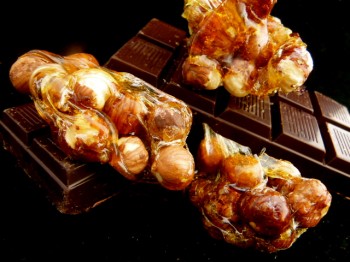
One day last summer I taught a class as a guest chef for a children’s camp.  There were two featured ingredients and I was asked to teach the “campers” a few recipes with each ingredient.  In class, we discussed what other flavors paired well with our subject ingredients. When the topic of nuts arose, one camper asked if I knew how to make a certain chocolate hazelnut spread.  So that day we not only made our recipes with the featured ingredients, but we also made a chocolate-hazelnut spread which we added to some crêpes. The spread was a hit with all of the campers.

Ski season brings with it cold-nosed ski bunnies (of all sizes) with hungry tummies to match.  While hot chocolate is the customary snacking treat, it does not fill you up after you have been zipping down the slopes (and it is often made with a terrible powder, barely hydrated with water, and the result is usually not worth the styrofoam cup it comes in).   I thought about this spread and how a warm chocolate praline spread on crisp French bread would be the perfect alternative.  Easy and delicious, on the slopes or off, this week’s simple pleasure is a chocolate praline tartine.

In France, praliné is everywhere.  Praliné is a general term to describe sugar coated almonds (sometimes hazelnuts).  Whenever there is a fête (celebration) be it Bastille day or a seasonal food or flower festival, the elaborate candy carts roll in and with them come the praliné vendors (although praliné vendors are in Paris year round). Pâtisseries (pastry shops), including my favorite Pierre Hermé, add praliné to macarons as well as croissants, cakes, and brioche. In the States, “praline” is generally understood to mean sugar coated pecans with the addition of  butter and/or cream.  Unfortunately, there are as many poor renditions of pecan praline as there are instant hot chocolate,  so do not let that dissuade you from trying something new.

This spread is a combination of a hazelnut praline and chocolate with a little olive oil.  No cream or butter is added.  The spread takes 10-15 minutes to prepare and it stores for a long time in the refrigerator (assuming you can keep your family’s hands off of it).  It does solidify when cold,  because it contains no preservatives, but it only takes 1 minute in the microwave to revive it.

The spread is extremely versatile. In addition to tartines, you can pour the spread over a banana slice, apple wedges, pear slices, pineapple slices, orange slices (in the summer, strawberries).   You can put it in a fondue bowl and dip fruit (fresh or dried), marshmallows, graham crackers or bread sticks in it.  It is a delicious topping for ice cream or yogurt.  Pour it in the middle of a hot soufflé or use it as a crêpe filling (or to top your Sunday pancakes or waffles).   Honestly, you could simply eat it right off of your own fingers and you would be a “happy camper.”

A couple of production and ingredient notes.  First, if you do not have hazelnuts, almonds, pecans, walnuts, or macadamia nuts are excellent substitutes. Second, be very careful when cooking sugar (definitely not a time to cook with the baby in the Bjorn).  When the sugar reaches an amber color, it will be between 310 and 320 degrees Fahrenheit.  If you splash it on you, it will stick to your skin and burn you. Third, when cooking sugar, as the moisture is cooked out, the sugar becomes hotter, darker, and cooks quicker.  Turn down the heat when the sugar is thickening because when it gets close to an amber color, it will go fast and if you cook it too long it will turn bitter.

Lastly, when cooking (and cooling) sugar there is a potential for crystallization or “seeding.”  You do not want this.  This is when the sugar (sucrose) molecules seek out one another and bond, forming crystals.   It results in a gritty, sandy texture and if you have ever had Christmas fudge that tasted gritty instead of smooth, then you know what crystallization tastes like.

You can tell if your sugar had seeded because the bubbling sugar will take on a cloudy/chalky appearance.  Once seeding has begun, it will rapidly continue and you cannot recover from it.   To prevent it, make sure that there are no sugar granules on the interior sides of the saucepan (because sugar pieces on the side of the pan have no water to separate the molecules from one another they have the freedom to attach to one another and spread “the seed”, my slang).

I wrote the attached recipe to minimize the chance of seeding.  Placing a bowl on top of the saucepan creates condensation which will drip down the pan sides washing down any misbehaving sugar granules; however, do not leave the bowl on the pan too long or your sugar will not cook.  If you still have some granules on the pan sides, use a wet pastry brush to wipe down the sides.  Do not stir the sugar or otherwise dip the brush into the sugar; only use the brush to wipe down the interior sides of the pan.  Also, do not shake the pan while the sugar is cooking because the agitation can cause seeding (the movement will cause the sugar molecules to collide).  You can add some “inverted” sugar (i.e., a tablespoon of corn syrup or honey) to help prevent crystallization (inverted sugar is when the majority of the sucrose has been broken down into fructose and glucose and results in a syrup consistency which is only 1/4 sucrose).   However, if you follow the recipe as written and follow these tips, you will not need to add the inverted sugar.  Fifteen minutes of effort and your campers and ski bunnies will all say: “chocolate praline tartine …

miam-miam !” (yummy).

Je vous souhaite un bon appétit !

LM

Read the rest of this entry »


a paper crown

January 6th, 2011

a paper crown

For Christians January 6 signifies l’épiphanie (the Epiphany).  The Epiphany is the twelfth day after the birth of Jesus; the day the three Magi found the baby in Bethlehem and bestowed upon him gifts of gold, frankincense and myrrh.  In France, the Epiphany is celebrated with la galette des rois (also known as the “twelfth night cake” or simply “king cake”).

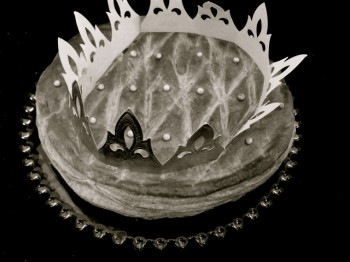
La galette des rois consists of two layers of puff pastry with a frangipane (almond cream) filling.  It is garnished with a paper gold crown.  What makes the cake special; however, is the trinket, la fève (a fava or broad bean), that is hidden inside.  Tradition dictates that the person who’s slice contains la fève is crowned king or queen for the day and gets to wear the crown.  To ensure that the distribution of la fève is completely random, the youngest person present goes under the table and calls out the order of the cake recipients.  An extra piece of the cake is sliced, la part du pauvre (the poor man’s share), should anyone of lesser financial means happen to stop by the house.  Today the tradition of la galette des rois extends beyond the religious context and the cake is sold and enjoyed in January generally, not just on January 6.

For me, la galette de rois, takes a very personal significance as well.  Three years ago to the day an ICU nurse gave me her crown (she had found la fève).   I still have it and the crown reminds me of how fleeting and precious life is.  This year my New Year’s resolution is the same that is has been for the last two years:  to eat a piece of la galette des rois because I know that the ability to look down at the crown on the cake and enjoy a piece with those you love is like finding la fève every day.

This week’s simple pleasure is la galette des rois. It is very simple to make and a fun tradition.  The active recipe time is about 20 minutes.  Nuts are decisive: you either like them in dessert or you do not.  If you like almonds, you will love this cake. However, if you are a person who is not crazy about almonds, you can replace the almond extract with vanilla extract or another extract such as orange.  You can also minimize the almond flavor by adding melted chocolate to the almond cream or mixing in a little strawberry jam with rose water.  However, do not add too much moisture (maxiumum of 2-3 ounces) or you will have soggy puff pastry.  With respect to the crown, you can buy the gold crowns at speciality stores or on the internet; however, you can easily make one of your own.

Forget the diet.  This week let’s all eat a piece of cake. Je vous souhaite un bon appétit !

LM


Read the rest of this entry »


start the new year with something good

December 31st, 2010


a new hors d’oeuvre for the New Year

2011 is almost here and I cannot wait.   I am ready to get past the large meals, stuffings, and the sugary treats that dominated my December 2010.  Seafood is a wonderful contrast but it seems like I see the same hors d’oeuvres over and over.   New year.  Time for something new.  So the issue is whether we can have a lighter hors d’oeuvre that is special enough for a New Year’s celebration but easy to prepare at the same time?  Of course we can.   This week’s simple pleasure is just that: shrimp saor cocktail.

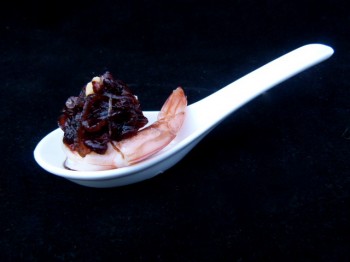
The shrimp saor cocktail is my take on shrimp cocktail. Saor is a traditional dish from Venice, Italy.  It is thinly sliced onions (usually white or yellow) that have been marinated in a sweet and sour sauce made of wine, sometimes vinegar, and sugar.  Typically saor is served on top of steamed or grilled sardines (“sarde in saor”) although it can grace the likes of more expensive lean fish such as dover sole. Saor is served with raisins, currants, pine-nuts, and often polenta cakes.  It can also be served with a small green salad.

This dish is ideal for New Year’s because you can prepare the saor the day before (it actually tastes better if you let it refrigerate overnight) and it is served at room temperature.   While you can steam the shrimp, I think sautéing the shrimp and serving them warm is ideal for this cold weather.   Either way  the active time for this recipe is about 25 minutes.

The saor shrimp cocktail can be a passed hors d’oeuvre or served as a first course if you are having a sit-down dinner.  If you want to fancy it up a bit, you can serve it on a bed of creamy white, warm polenta or a squash purée (the sweetness of the squash pairs wonderfully with the tartness of saor).  If you have leftover saor, it is great on burgers or on a brie sandwich with green apple slices.  It will also keep in the refrigerator for at least a week.

A couple of notes on the ingredients.  Do not use expensive balsamic vinegar for the reduction.  Use good balsamic vinegar, but do not use balsamic vinegar that has been aged longer than you have been alive.  It is a waste.  Save the expensive vinegar for finishing salads or drizzling over other items.  With respect to the shrimp, you can use either prawns or smaller shrimp.  Make your choice depending upon your individual circumstances (whether these are passed hors d’oeuvres,  stationary at a buffet, or plated as a first course).  You will see that in the recipe in parenthesis there is a number next to the shrimp (i.e., “11/15” for the prawns).  That means that you will get 11-15 prawns per pound, just so you have an idea of how many to buy and the price.  Also, because the saor stores so well, you do not have to buy and make 24 prawns.  If you only need 12, make 12 and use the extra saor for something else delicious.

Je vous souhaite bon appétit, de joyeuses fêtes et une très bonne année (I wish you Happy Holidays and a Happy New Year).


LM

Read the rest of this entry »


Bœuf de Noël

December 24th, 2010

Bœuf de Noël

Every year a number of home-cooks try their hand at creating the French classic Bûche de Noël (also known as the Yule log or Christmas log).  The Bûche de Noël signifies the European tradition of placing a Yule log on the fire during the Christmas holidays.  The Bûche de Noël, an edible rendition of a yule log, is a génoise sheet cake covered with buttercream.   The cake is then rolled,  creating a swirling pattern of cake and buttercream visible from the sides.  The rolled cake is covered with frosting, scored to create tree bark appearance, and decorated with marzipan mushrooms and sometimes marzipan holly leaves.   This week’s simple pleasure takes the theme and techniques of a Bûche de Noël and applies them to the savory side.  Instead of a dessert, we are making the main course.

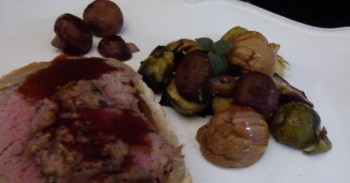
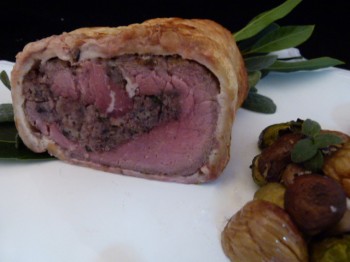
Bœuf de Noël (not a French tradition but my own play on words) is a beef tenderloin, butterflied to a thickness of one inch, covered with a delicate chestnut and fresh herb stuffing, rolled, and then enclosed and roasted in puff pastry dough.  You can dress up the dish by adding foie gras or wild boar sausage to the stuffing.  Truffles can be also added (either to the stuffing, the sauce, or sliced and sautéed and served with the mushrooms);   however, the recipe is written with just the basic ingredients (but if you have these specialty items on hand, use them!)  The idea is similar to France’s rôti de boeuf en croûte (roasted beef in pastry) or England’s Beef Wellington (a popular dish in the 1960’s), except this recipe uses the French preparation technique of roulade (basically stuffing and rolling a food) as well as the en croûte method (to enclose a food in dough) and it resembles the Bûche de Noël in spirit.

In addition to the woodsy flavors (sage, thyme, chestnuts), this main course looks like a yule log.  The puff pastry is scored to create the appearance of bark.  You can also add “tree limbs” by rolling smaller bits of puff pastry and attaching them to the “trunk” (let your imagination be your guide for this).  When you slice into the tenderloin, there is not only the pastry puff layers (the “bark”), but the swirling patten of the stuffing and the meat, resembling the tree’s rings.  Instead of marzipan mushrooms, sautéed whole small brown mushrooms (combined with wild mushrooms if you like) are served on the side to complete the yule log.  A thyme-port reduction sauce is a perfect compliment to the stuffing, meat, and the pastry.

While the dish may sound a little complicated, it is not.  Cut.  Stuff.  Roll.  Roast.  This is a great dish for a holiday dinner because it is special enough that your guests will not see it every day yet it is simple for the host because the majority of it can be ahead of time.  On the day of your dinner, all you have to do is roast the meat and prepare the sauce while the meat is in the oven and then resting.  You can make this dish with a less expensive cut of meat (such as a flank steak); however,  the tenderloin is the better choice because the delicate, tender cut pairs best with the puff pastry, the smooth sauce, and the fine-textured stuffing.  Turkey breast also works, but  I imagine most people are tired of turkey after Thanksgiving.

A couple of ingredient and production notes.  While I usually advocate making everything from scratch, you only need one sheet of puff pastry for this recipe so if you do not have it on hand, it can be purchased  in the freezer section of your grocery store or speciality food store.  There are actually some decent puff pastry doughs out there (although there are some bad ones too). Buy a quality puff pastry, defrost it in the refrigerator, and make sure that it is not too thick (roll it with a rolling pin if it is).  Also, make sure the pastry dough is cold but pliable when you wrap it around the meat.  Once you have wrapped the meat, return the entire thing to the refrigerator for about 15 minutes (although you can do this the day before and put it in the refrigerator overnight).

You want to make sure the meat is cooked correctly and that the puff pastry is golden brown and and not doughy or soggy.  The latter I find to be the biggest trouble spot.   According to Harold McGee, about 75% of a meat’s weight is water and as meat cooks, the meat firms up, squeezing out the  moisture.   This water (the juice) has to go somewhere so even a barrier between the pastry and the meat (i.e., prosciutto or pâté) will not eliminate the moisture factor.   I find that the best way to deal with this is to minimize it: (1) use a thin layer of quality pastry dough and do not overlap it; (2) score the dough to allow heat to penetrate the pastry dough, (3) bake the log on a wire rack to allow the oven heat to surround the log (I also make some fork piercings in the bottom of the dough as an escape route for cummulative moisture);  and (4) start the oven off at a high temperature, even though you have already browned it in a skillet, which will allow pastry to rise better and turn some moisture into steam.    Also, if the meat is not too big (if you roast only 1 pound instead of 2), you can turn it on its side  when it cools so any draining juice will not sit on the bottom of the puff pastry.

Lastly, the meat should be taken out of the oven when it registers 130 degrees Fahrenheit on a meat thermometer.  This will give you medium/medium-rare meat that is still pink in the middle which is what you want.   Normally, I would suggest taking it out at a much lower temperature but the enclosing the meat in pastry artificially raises the temperature of the meat (and also prevents it from cooking as it would without the pastry around it).

Serve this dish with simple roast winter vegetables (see companion post) or a creamy winter soup.  Below I have included the recipe for the thyme-port sauce as well as sautéed mushrooms to go with the Bœuf de Noël.

Whether you make a Bûche de Noël or a Bœuf de Noël (or both),  je vous souhaite un bon appétit et je vous souhaite un très Joyeux Noël  du fond de mon coeur (and I wish you a very Merry Christmas from the bottom of my heart).

LM

Read the rest of this entry »


roasted brussels sprouts and chestnuts

December 24th, 2010

roasted brussels sprouts and chestnuts

serves: 6-8

what you need:

1/2 cup lardon or pancetta, cubed
1 pound brussels sprouts, halved
12 chestnuts, steamed and halved (shells and skins removed)
olive oil (as needed)
kosher salt (as needed)
freshly ground black pepper (as needed)

how to:

  • Prepare Chestnuts.  Cut in half.
  • Partially Cook Lardon or Pancetta.  In a cast iron skillet (or in the microwave on paper towels), cook the pancetta or lardon until  the meat has pinked up.  Do not cook all the way and do not cook until crispy.  Drain on paper towels.  This step is merely to eliminate the majority of the animal fat.
  • Prepare Brussels Sprouts.  Wash and dry brussels sprouts.  Cut in half lengthwise.  Add to bowl with chestnuts.  Add drained pancetta or lardon.
  • Coat With Oil.  Coat the brussels sprouts and chestnuts lightly with oil and sprinkle with kosher salt and pepper.  Toss to coat.  Place in a baking dish.
  • Roast. Roast in an oven preheated to 350 degrees Fahrenheit.  Use a wooden spoon to toss the brussels sprouts, chestnuts, and meat to ensure even cooking.   Cook until the brussels sprouts are slightly browned and some of the edges are crisp.
 

gingerbread dolls – delicious and fun

December 17th, 2010

gingerbread dolls

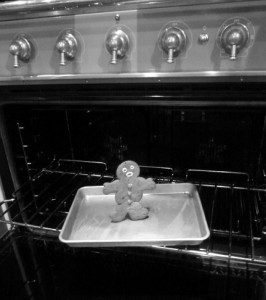
The holidays are a time when parents take multi-tasking to all new levels.  I have children myself so I am no exception.  In fact, I became very aware of my parental multi-tasking when during a lunchtime run I simultaneously collected mulberry tree trimmings for garland and table decor,  planned dinner menus and organized their execution in my head while at the same time listened to Selena Gomez (just to stay current on the music my children are listening to).   A woman, walking her dog, stared at me and her gaze made me conscious of how absurd I looked running with my large collection of mulberry branches in each hand, singing Selena Gomez songs.   The explanation “I’m a mom” immediately spilled from my mouth and she laughed.  She understood.  It is the final push before winter break and parents are scrambling to get everything done for the holidays before the children are home needing projects to do.   I have an answer to both (at least for one afternoon): gingerbread dolls.    An edible version of paper dolls, this project gives you your gingerbread for the holidays and the kids a project too.

While you can buy gingerbread kits in the stores, I have yet to find one that actually tastes good.  These gingerbread cookies are chewy and moist, crisp around the edges, spicy, but not too much, and hold their shape for decorating.   The recipe is simple and written with children in mind.   Instead of creaming the eggs and the butter, this basically uses a one step method (you can use a stand alone mixer or a food processor) which makes it not only easy for children but “child-proofs” the tendency to over-cream the sugar and butter, which causes the cookies to spread.   I have included two recipes: one written for adults (below); and the second written (with pictures) that a beginning reader can follow.

Once the cookies are made, rolled fondant is used to make the clothes.  Fondant can be purchased online and at cake supply stores and well as craft stores.   You can purchase it in a variety of colors but white can be easily colored by adding food coloring.  Although there is a fondant rolling pin it is not necessary for this project.   If the fondant is sticking simply use a little powdered sugar on your hands and rolling pin.   A pie cutter, a dull knife, kitchen scissors (or even a plastic play-dough cutter) can be used to tailor the clothing.   Spices, sprinkles and candies make nice accessories but let your child’s imagination be their guide.  Use royal icing (recipe posted) to adhere the clothing to the cookies or if the fondant dries the clothes will come off of the cookie (which can be good too if your cookie is a fashionista and wants to change her clothes).

A couple of notes on the ingredients.  This recipe uses both dark muscovado sugar and dark brown sugar.   Muscovado is unrefined sugar made from sugarcane juice which has a high molasses content.  It is a wonderfully spicy, moist and aromatic.   It adds a richness to the cookies that dark brown sugar alone cannot give you.  It also has small, dark bits of  molasses-sugar which adds character in appearance and taste (all gingerbread should have freckles as well as laugh-lines).  You can crush them for a more uniform look but the small bits do not affect the cookie adversely unless they are too big.   Do not use muscovado sugar exclusively for cookies or they will be too spicy.  You can eliminate it and use only dark brown sugar; however, do not use light brown sugar or the cookies will be plain and uninteresting (in taste and appearance).

Make sure your butter is room temperature (which means it is pliable but not too soft).  Cut it into chunks because you want to make sure it is incorporated with the other ingredients.

Molasses is the ingredient which gives gingerbread its character.  Molasses is the liquid byproduct of boiling sugarcane until the sucrose crystalizes to create granulated sugar.  There are three grades of molasses and the difference lies in which boiling (the first, the second, or the third) produced the molasses.  All grades can be sulphured or unsulphured.  Light molasses is produced from the first boiling, dark molasses from the second, and blackstrap from the third boiling.   The molasses I recommend using for these cookies is Grandma’s original unsulphured molasses (yes, the very same one our parents used when we were kids).  I have tried several, the organic ones, the darker molasses, and blackstrap, and while I use these others for spice cakes, they are too spicy for cookies.

Lastly, under-bake the cookies to achieve a chewy consistency. When small cracks in the cookies begin to form, take the cookies out of the oven and let the carry-over heat from the baking pan continue to bake the cookies for about 2-3 minutes.  Then place the  cookies on a metal rack to cool.  If you want crisp cookies, bake them longer, roll them flatter, and/or reduce the oven temperature slightly.   Store the cookies in an air-tight container for freshness and they should last a few days (assuming they are not eaten before then).

Simple.  Delicious.  Project!

Je vous souhaite un bon appétit !

LM

Read the rest of this entry »


gingerbread dolls (recipe for children)

December 17th, 2010

gingerbread doll recipe for children

The following is a recipe written specifically for your children who are reading and want to spread their wings in the kitchen. Of course, as their parent only you can judge how much supervision is requried with respect to the operation of a stand alone mixer, a food processor, and the oven.  If you show them how to measure ingredients, they should not have a problem following the rest of the recipe.  Making the gingerbread “clothes” is a pure exercise in creativity, akin to playing with play-dough.   Pull several items out of your pantry (raisins, sprinkles, nuts, left-over Halloween candy, licorice, sprinkles, etc) and see how creative your children can be.

Je vous souhaite un bon appétit !

LM
Read the rest of this entry »


royal icing

December 17th, 2010

royal icing

what you need:

1 1/4 cup powdered sugar, sifted
1 tablespoon dried egg whites (or meringue powder)
1 teaspoon lemon juice
1/8 cup water

OR

1 1/4 cup powdered sugar, sifted
1 egg white
1 teaspoon lemon juice

how to:

  • Sift Dry Ingredients.  Sift powdered sugar and meringue powder (or dried egg whites) and place in the bowl of a stand along mixer.
  • Add Liquid And Mix.  Using the whisk attachment, turn the mixer on low speed and add the lemon juice and water.  Mix until incoporated.  If you are using a raw egg white (instead of the dried whites or meringue powder), omit the water.
 

warm from the inside: marrons chauds and vin chaud

December 11th, 2010

les marrons chauds et le vin chaud
(roasted chestnuts and mulled wine)

The holiday season in Paris is magical: children with their faces pressed against the windows of Galeries Lafayette and Printemps watching the marionettes; l’avenue des Champs-Élysées flanked with lights; people lined up out the door at G. Detou to buy marrons glacés; the skating and winter activities at  L’Hôtel de Ville; the festive holiday teas at Dalloyou and Ladurée; the spice cakes at Mariage Frères.  The list goes on.  The entire city is tastefully decorated and the spirit of the season spills out of the pâtisseries and speciality shops into the streets where the smell of les marrons chauds (roasted chestnuts) and le vin chaud (hot wine or “mulled wine”) permeate the air.  The smell of the two instantly transport me to Paris.   This year you can bring these holiday traditions into your own home, without the security checkpoints and the (unusual and early) Parisian snow.

Roasted chestnuts and mulled wine are wonderful, simple treats you will want to make year after year.   The chestnuts take only about 15-20 minutes to roast in the oven and the wine simmers stovetop for about 45 minutes.   If you do not want to use wine, you can use cider instead.  Below are a few notes about purchasing, storing, and preparing chestnuts.  The mulled wine recipe and notes are in a companion post under “recipes”.

Chestnuts can be found in your local grocery store or ordered online.  There are several varieties of chestnuts, but the ones you see most often are the marrons (the round chestnuts used for marrons glacés (sugar-iced chestnuts)  and the chatanges (chestnuts which are flat on one side).   In the States, you rarely see the fresh marrons.

When buying fresh chestnuts, choose chestnuts with shiny brown shells and without blemishes (which indicate that they have been stored too long or improperly).   Chestnuts should be sold in the refrigerated produce aisle, and if they are not, be cautious about your purchase because they perish easily.   Chose chestnuts that are firm but give slightly when you score them.  If the chestnut gives too much, that means that it may have begun to spoil (sometimes they smell a little musty indicating they have gone bad).  Similarly, do not purchase chestnuts if they rattle indicating that they are really old and dehydrated.  Store chestnuts in the refrigerator where they will last a few weeks.

When roasting chestnuts you must always score the shell or the chestnut will explode due to the steam created under the shell.  I find that a modest incision is best as it traps more steam inside the shell and makes the skin easier to remove (if the nut is dehydrated either due to age or over-roasting, the skin will be very hard to remove).  You can tell if a chestnut is dehydrated if the creases in the nut have collapsed and the nut looks withered.  You do not need to add any oil to the nuts before roasting them in the oven.  However, once peeled, I like to garnish the chestnuts by adding a touch of nut oil and a couple granules of fleur de sel.  Olive oil is too strong so I avoid finishing with it.  Serve the chestnuts while they are warm.

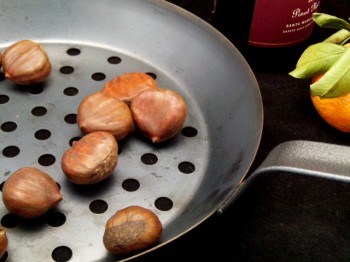
A couple of equipment notes, chestnut knifes are great because the short, pronounced blade makes it easier to score the shells. However, a paring knife works fine.  There is a pan made for roasting chestnuts made by de Buyer (poêle à marrons) which you can purchase online or at kitchen supply stores such as Sur La Table.  However, while the pan is great (and preferable for grilling the chestnuts), chestnuts roast just fine in a normal oven-proof pan or on a baking tray.

Lastly, if you do not roast all of the chestnuts,  there are many ways to use them.  They can be sautéed, braised, boiled, puréed, grilled, and steamed.  They are wonderful additions to soups, stuffings, sauces, and accompaniments to all kinds of game as well as veal, beef,  bacon, and poultry.   Chestnuts are substantial enough to serve on their own as a side-dish and historically have been used as a vegetable due to their  meaty texture and high starch content.   Chestnuts pair well with other Fall and Winter flavors:  sage, thyme, winter squashes, mushrooms, onions, brussels sprouts, kale and swiss chard, grapes, raisins, oranges, and apples (to name a few).   Naturally sweet, chestnuts are wonderful in a variety of desserts and baked goods. Chestnut honey is divine.

Je vous souhaite un bon appétit !

LM
Read the rest of this entry »


vin chaud

December 11th, 2010

vin chaud

Le vin chaud (hot wine or “mulled wine”) is a warm, festive treat for the holidays that is easy to make (the simmering wine makes your home smell good too).  Here are a few suggestions to help you with your preparation.

First, I like to toast the spices and fruit in a dry pan before adding the wine because that intensifies their flavor.   Once the spices are fragrant and a fond from the fruit has begun to form on the pan bottom, I add a touch of brandy and then immediately add the wine. The brandy adds a nice depth to the wine and releases the fond from the pan (however omit the brandy if you are simmering cider instead of wine).

Second, simmer the wine for about 45 minutes.   Do not boil the wine or simmer longer than one hour or the wine will become bitter.  Do not simmer for less than 30 minutes because the spices will not have been infused.  You can add additional spices to your taste (I often I add licorice root as well); however, do not add any ground spices or your wine will be chalky and cloudy.

Third, most mulled wine recipes add sugar to the wine (anywhere from 1/4 to 1 cup per bottle).   I omit the sugar completely.   It is not necessary and wine already has sugar in it.  However, I do add a couple of dried cherries (you can use raisins if you want) which slightly sweeten the wine and compliment the fruit overtones in the wine.

Fourth, with respect to the wine, avoid earthy Bordeauxs and full-bodied Cabernets.  Use a medium-bodied red wine such as a Pinot Noir or Red Zinfandel (although Merlot and Shiraz could work as well).   I include two Pinot Noir recommendations below (thanks to my friend Mark at The Wine House).  The Cloudline (from Oregon) is more fruit forward while the Santa Maria Pinot is more of a subtle, classic Pinot Noir.  Choose according to your taste preference.

Lastly, I am always asked how much money to spend on a bottle of wine with which you are going to cook.  In my opinion, you can neither select nor eliminate a wine based solely upon price  (price is also subjective).   Instead, my rule of thumb is that you should buy a wine that you would drink and enjoy but not a wine that you would sip and savor.

Santé !

LM

Read the rest of this entry »